
+86 136 0176 4940
info@akoetech.com
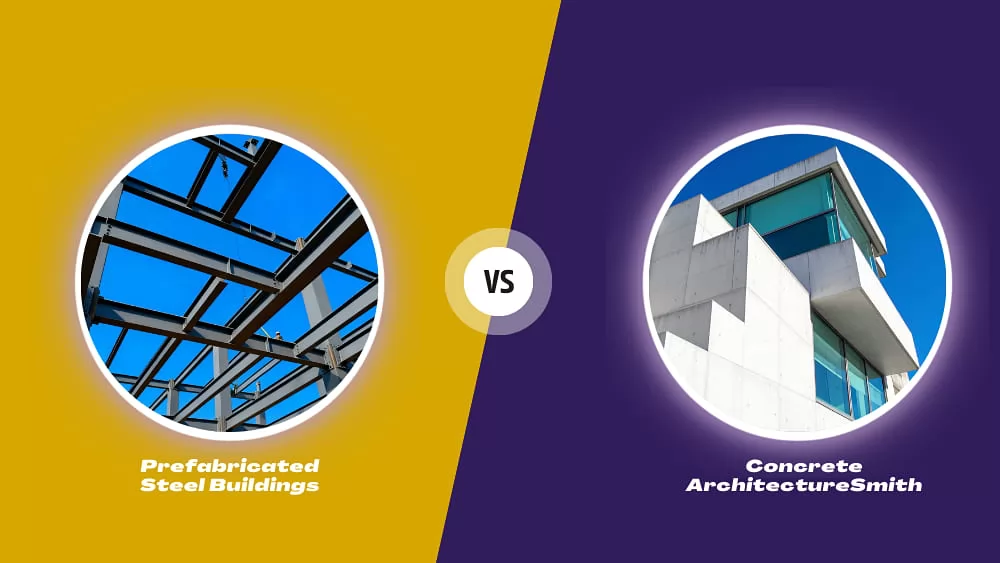
If you're trying to decide between a prefabricated steel building and a precast concrete structure, you're probably already dealing with a real project — a warehouse that needs to be up before the busy season, a facility that has to meet strict fire codes, or a development where the budget needs to stretch as far as possible. You're not looking for a textbook answer. You want to know which material actually makes sense for your situation.
The honest answer is: it depends. But that's not as unhelpful as it sounds. Steel and concrete each have a clear set of conditions where they genuinely outperform the other — and once you understand what those are, the decision usually becomes straightforward. This guide walks through the real differences across cost, construction speed, durability, performance, and long-term flexibility, so you can make a call you're confident in.
A prefabricated steel building is a structure where all major components — columns, beams, roof panels, and wall systems — are engineered and manufactured in a factory, then shipped to the site for rapid assembly. Because everything is pre-cut and pre-drilled to exact specifications, erection typically takes days or weeks rather than months. These buildings are widely used for warehouses, industrial facilities, agricultural structures, and commercial spaces, valued for their large clear-span interiors (often 30–90 meters without interior columns), design flexibility, and the ability to expand or relocate the structure in the future. Steel's high strength-to-weight ratio also means lighter foundations compared to concrete equivalents.
A prefabricated concrete building uses structural elements — wall panels, floor slabs, beams, and columns — that are cast and cured in a controlled factory environment, then transported to site and assembled. Unlike poured-in-place concrete, this approach brings the quality control benefits of factory production while significantly reducing on-site construction time. Prefab concrete is common in residential apartment blocks, schools, parking structures, and public buildings where fire resistance, thermal mass, acoustic insulation, and long-term durability are priorities. Once assembled, these structures require minimal maintenance and can comfortably serve their intended use for 50 years or more. To understand more about how prefabricated buildings work in general, see What Are Prefabricated Buildings: Everything You Need to Know.
The table below summarizes the most decision-relevant factors across both systems. Each factor is explained in detail in the sections that follow. You can also explore a full side-by-side comparison of prefabricated building systems on our dedicated Comparisons page.
| Comparison Factor | Prefabricated Steel | Cast-in-Place Concrete | Verdict |
|---|---|---|---|
| Construction Speed | 40–60% faster; bolted assembly, no curing time | Slowest; requires formwork, pouring, and curing (28+ days per cycle) | ✔ Steel |
| Overall Project Cost | 10–20% lower total cost (shorter schedule, less labor) | Lower material cost but higher labor and overhead | ✔ Steel |
| Prefabrication Rate | 95–100% factory-fabricated | 0% (all work on-site) | ✔ Steel |
| Design Flexibility | Large clear spans (up to 60m+), open interiors | Structural columns limit interior space | ✔ Steel |
| Seismic Performance | Excellent; high ductility absorbs seismic energy | Good when well-designed; poor with inadequate rebar | ≈ Equal (well-designed) |
| Fire Resistance | Requires intumescent coating; 4h+ achievable | Inherently fire-resistant; no additional treatment needed | ✔ Concrete |
| Long-Term Maintenance | Minimal; no repainting if galvanized; no cracking | Requires resealing, crack repair every 10–15 years | ✔ Steel |
| Sustainability / Recyclability | 100% recyclable; fully demountable and reusable | Demolition waste; concrete is largely non-recyclable | ✔ Steel |
| Suitability for High-Rise (30F+) | Hybrid systems used; core still often concrete | Industry standard for supertall structures | ✔ Concrete |
| Exportability | Ships worldwide in standard containers | Cannot be exported; requires local materials | ✔ Steel |
| Labor Skill Required | Ordinary workers; bolt-only assembly | Multiple skilled trades (formwork, rebar, concrete pouring) | ✔ Steel |
| Weather Dependency | Minimal; assembly continues in most conditions | High; cannot pour in rain/extreme cold | ✔ Steel |
A pre-engineered steel building is the right call when speed, flexibility, and cost efficiency are your top priorities. If your project has a tight delivery timeline, steel wins by a wide margin — components arrive ready to bolt together, and most structures are fully erected in weeks.
Components are factory-made and arrive on site ready to assemble. Most steel buildings are fully erected in weeks, not months — making it the go-to choice when an early opening date drives the project. If build cost is part of your decision, our complete steel building cost guide breaks down what to expect at every stage.
Pre-engineered steel frames routinely achieve clear spans of 30–90 metres without interior columns. This makes them the natural fit for warehouses, distribution centres, and manufacturing plants where unobstructed floor space is critical to operations.
A bolted steel frame can be extended by adding bays, raising the roof height, or relocating the structure entirely. If your business is likely to grow, steel gives you options that concrete simply cannot. See how long prefabricated steel buildings last to better understand their long-term value.
Steel's natural ductility allows it to flex and absorb ground movement without sudden brittle failure. In earthquake-prone regions, a pre-engineered steel frame often meets code requirements more cost-effectively than a concrete alternative — as demonstrated by projects like our Turkey earthquake-resistant housing and Senegal seismic housing projects.
Steel erection crews are mobile and require minimal site infrastructure. In rural or remote locations where skilled concrete labour is scarce, prefabricated steel significantly reduces both risk and cost. Our export price guide covers what international buyers need to know about shipping and supply logistics.
Precast concrete earns its place when longevity, low maintenance, and building performance are the deciding factors. If you're developing a structure expected to serve its purpose for 50 years or more, precast concrete's durability and near-zero upkeep cost make it the more economical choice over the full life of the building.
Once installed, precast concrete requires virtually no ongoing upkeep — no repainting, no corrosion treatment, no protective coatings to reapply. For owner-operators planning to hold a building for decades, the lifetime cost is substantially lower than steel. For a full cost comparison, see how to calculate the cost of prefabricated buildings.
Concrete meets the most demanding fire resistance ratings inherently, without additional intumescent coatings or structural encasement. For hospitals, schools, high-rise residential, and public buildings, this simplifies compliance and reduces cost.
Concrete's density naturally limits sound transmission between floors and units — a key requirement for apartment blocks, hotels, and office buildings. Its thermal mass also stores and releases heat slowly, reducing HVAC loads in climates with significant day-to-night temperature variation. Our S-CAS CCP Panel system and envelope system are engineered specifically to address thermal and acoustic performance in prefabricated construction.
Precast panels can be cast into curved profiles, textured surfaces, and precise geometric forms with consistent quality across every unit. If your design calls for a refined, repeatable exterior finish, precast concrete delivers it more reliably than site-poured or steel-clad alternatives. Explore the CCP connection technology that makes this possible at scale.
For residential towers, parking structures, and institutional buildings where load-bearing walls, floor spans, and fire compartmentalisation all need to work together, precast concrete systems are purpose-built for the task. See our mid-rise and high-rise building solutions for real-world applications, including the Brazil 5-storey apartment project.
Prefabricated steel has a higher strength-to-weight ratio, allowing it to span greater distances with less material; prefabricated concrete offers higher compressive strength per unit volume. At a structural engineering level, both materials are suitable for most building types — the key question is not which is "stronger," but which better meets the structural demands of your specific project. Learn more about our S-CAS steel structure system and how it is engineered for demanding applications.
On a total project cost basis (including labor, formwork, financing, and full lifecycle maintenance), prefabricated steel is typically 10–20% less expensive than prefabricated concrete. Although steel's unit material cost is higher, this premium is offset by lower labor requirements, the elimination of formwork, and a shorter construction schedule that reduces financing costs. For a detailed breakdown, read our guide on how much a steel building costs in 2026, and our insulated steel building cost guide if thermal performance is a factor in your budget.
For equivalent projects, prefabricated steel typically completes in 40–60% of the time required for prefabricated concrete. Once foundations are ready, steel erection proceeds at approximately 3–5 floors per week. Prefabricated concrete, due to its lifting, jointing, and curing requirements, progresses at roughly 1 floor per 4–6 weeks for a project of similar scale — a significantly longer schedule. Our S-CAS steel connection technology is specifically designed to accelerate on-site assembly without compromising structural integrity.
The main advantages of prefabricated concrete include: (1) inherently superior fire resistance, requiring no additional fire-protective coatings or cladding; (2) stronger corrosion resistance, making it well-suited to high-humidity, coastal, or chemically aggressive environments; (3) concrete or composite systems remain the industry norm for supertall structures above 30 floors — see our high-rise building solutions; (4) lower raw material costs; and (5) generally better acoustic and thermal performance. The S-CAS CCP full life cycle page explains how our panel systems are designed to deliver concrete-level durability with improved constructability.
Prefabricated steel excels under seismic loading thanks to the ductility of steel — it deforms rather than fracturing under load, effectively absorbing earthquake energy. It is widely used in seismic zones, as shown in our completed projects in Turkey and Senegal. Prefabricated concrete can also achieve strong seismic performance through appropriate structural design. Both materials can be engineered to comply with any applicable national or international structural code.
Prefabricated steel is the dominant choice for warehouses and industrial facilities: it achieves clear spans of 30–60 metres without internal columns, meeting the layout requirements of logistics and manufacturing operations; crane systems integrate naturally into steel frames; and shorter construction schedules allow faster commencement of operations. Explore our dedicated industrial building solutions for specifications and case studies. Prefabricated concrete is better suited to industrial buildings with heavy floor loading, demanding corrosion-resistance requirements, or special fire-rating needs.
Prefabricated steel offers greater flexibility for future expansion: bays can be extended longitudinally, lean-to or full-bay additions can be appended laterally, and mezzanine levels can be inserted within the existing envelope — making it well-suited to businesses with growth plans. Prefabricated concrete can also be expanded, but modifications are typically more complex and costly. Future expansion interfaces should be planned at the design stage. Our S-CAS SCBIM system uses BIM-based planning to model expansion scenarios from day one, reducing costly design changes later.
There's no universal winner between prefabricated steel and precast concrete — and anyone who tells you otherwise is probably trying to sell you one of them. What there is, is a better fit for your project. If you need to build fast, keep spans wide open, or stay ready to expand down the road, steel is almost certainly the right call. If you're building something that needs to last 50 years with minimal attention, handle fire or acoustic requirements, or perform well in a tough climate, concrete earns its place.
Most of the time, the decision comes down to three things: your timeline, your budget horizon, and what the building actually needs to do. Get those clear, and the material tends to choose itself. If you're still weighing up the options for a specific project, we're happy to talk it through — no obligation, just a straight conversation about what makes sense for what you're building. Get in touch with our team or browse our completed projects to see how we've helped clients across four continents make the right call.
Your Name*
Your Email*
*We respect your confidentiality and all information are protected.

Explore the top 5 precast concrete panels manufacturers in Canada in 2026. Compare architectural wall panels, insulated panels, facade solutions, products, services and manufacturer strengths.

Discover the top 5 precast concrete panels manufacturers in China in 2026. Compare their products, strengths, applications, and capabilities for custom precast concrete panels.

Free poured concrete wall cost calculator. Enter length, height and thickness to see a price range for 12 countries, materials and labor included.