
+86 136 0176 4940
info@akoetech.com
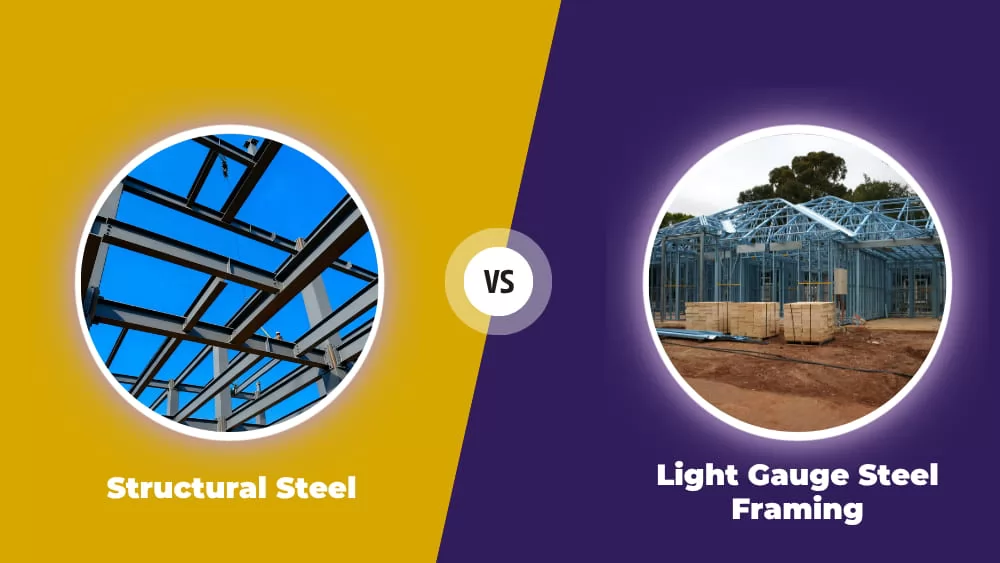
When planning a new build, renovation or interior fit-out, choosing between structural steel and light gauge steel framing is one of the most critical decisions you’ll make. These two widely used framing systems differ greatly in load capacity, application and construction requirements, which also means you need to partner with different specialists.
Whether you’re searching for experienced structural steel contractors, skilled light gauge steel framing contractors, professional metal stud framing contractors or all-round steel frame contractors, it’s essential to know exactly which solution suits your project. Let’s walk through their differences to find out what your project truly needs.
Here's the short version, for anyone who wants to screenshot this and move on:
Structural steel is the heavy, hot-rolled steel skeleton that holds a building up — beams, columns, wide-flange sections. It carries massive loads across long spans.
Light gauge steel framing (also called cold-formed steel or metal stud framing) is the thinner, roll-formed steel used for walls, partitions, and facade framing. It organizes interior and exterior surfaces. It does not replace the structure beneath it.
Two different animals. Two different crews. And mixing them up on a project can cause real problems — budget overruns, scope disputes, or worse, a structure that doesn't meet code.
Imagine you're building a five-story parking structure. Or a distribution warehouse with 40-foot clear-span bays. Or a high-rise office building that needs to carry thousands of people, mechanical systems, and decades of live load without so much as a creak.
That's structural steel territory.
Structural steel uses hot-rolled sections — the classic W-shapes (wide-flange beams), HSS tubes, angles, and plates you see being welded and bolted together by ironworkers. These members are thick, heavy, and engineered to precise tolerances. A W12×96 beam, for example, weighs 96 pounds per linear foot. You are not moving that with your hands.
The connections are typically bolted with high-strength fasteners (ASTM A325 or A490) or welded by certified welders following AWS D1.1 standards. Every connection is engineered. Every splice is calculated. The whole system is designed to the AISC 360 specification and reviewed by a licensed structural engineer.
If you're dealing with seismic design, moment frames, or a building that needs to resist hurricane-force winds across a 60-foot span — you need structural steel contractors and a full structural engineering team behind them. A steel-structure factory building is a good example of how this system comes together at scale: long clear spans, heavy overhead loads, and a frame engineered to last decades of industrial use.
Now let's talk about the other steel — the kind that's everywhere, and the kind most people have actually seen up close without realizing it.
Walk into almost any commercial office renovation, hotel corridor, or new apartment building. Chances are the interior walls are framed with C-shaped steel studs and U-shaped tracks. That's light gauge steel, also called cold-formed steel or, on most job sites, just metal studs.
These are thin. We're talking 18 to 25 gauge steel — roughly 0.033" to 0.097" thick. They're cold-formed (shaped at room temperature rather than heated), which gives them their characteristic cross-section shapes but limits how much load they can carry directly.
Installation is done with self-drilling screws, not bolts or welds. A skilled metal stud framing crew can layout and frame hundreds of linear feet of wall in a day. It's fast, dimensionally consistent, and doesn't shrink or warp the way wood framing can.
Light gauge steel is governed by the AISI S100 specification — a completely different standard from the structural steel world.
One thing worth saying clearly: light gauge steel can be load-bearing in low-rise construction. A well-engineered cold-formed steel wall assembly can carry vertical loads in a two- or three-story building. But it has real span limitations, and it is not a substitute for a structural steel frame in anything beyond light framing applications.
Let's be honest — most "comparison" articles stop at "one is heavier than the other." That's technically true and practically useless. What you actually need to know is why those differences exist, what they mean for your project, and where the boundaries are. So here's the full picture, first as a quick-reference table, then broken down one by one.
| Factor | Structural Steel | Light Gauge Steel Framing |
|---|---|---|
| Material type | Hot-rolled, heavy sections (W-shape, HSS, angle, plate) | Cold-formed, thin-gauge sections (C-stud, U-track, furring) |
| Typical member thickness | ½" to 2"+ flanges and webs | 0.033" to 0.097" (18–25 gauge) |
| Span capability | 30 ft to 300+ ft | Up to ~30 ft (engineered assemblies only) |
| Connection method | High-strength bolts (ASTM A325 / A490) and field welds (AWS D1.1) | Self-drilling screws, clips, and crimps |
| Who installs it | Ironworkers — certified structural steel erectors | Metal stud framing / light gauge steel framing contractors |
| Rough installed cost | $15–$35 per sq ft (structure only, varies by region) | $4–$12 per sq ft (framing only, varies by region) |
| Installation speed | Slower — crane picks, bolt-up, inspection hold points | Fast — large crews can frame thousands of sq ft per day |
| Primary structural role | Carries the full gravity and lateral loads of the building | Defines walls, partitions, and facade — does not carry primary loads |
| Best for | Multi-story, long-span, heavy-load buildings | Interior walls, exterior framing, low-rise construction |
Numbers above are reference ranges — your actual costs will depend on your market, project complexity, and current steel pricing. But the relationship between the two systems holds: structural steel costs more because it's carrying exponentially more load. You're not comparing apples to apples. You're comparing apples to a forklift.
This is where everything starts, because the manufacturing process is what creates the difference in strength, weight, and application.
Structural steel members are hot-rolled. That means the steel is heated to over 1,700°F and then pressed through rollers to form its final shape — I-beams, wide-flange sections, hollow structural sections (HSS), angles, and plates. The result is a dense, heavy member with substantial cross-sectional area and the ability to carry enormous loads. When you see ironworkers connecting a W14×90 beam to a column on a high-rise, that beam weighs 90 pounds per linear foot. It's not going anywhere.
Light gauge steel members are cold-formed. Room-temperature steel coils are fed through forming dies that bend and shape them into C-studs, U-tracks, and furring channels without any heating. This process produces precise, consistent shapes at high speed — but the resulting members are thin and light. A standard 3-5/8" metal stud might weigh less than a pound per foot. It's strong enough for walls. It's not a column replacement.
Think of it this way: hot-rolling creates mass and structural depth. Cold-forming creates precision and coverage. Both have their place. Neither does the other's job.
The thickness gap between these two systems is striking when you hold them side by side. A structural steel wide-flange beam might have flanges half an inch to two inches thick. The web connecting those flanges adds more material. The whole section is engineered to resist bending, shear, and axial forces simultaneously.
A 25-gauge metal stud — the lighter end of the light gauge range — is about the thickness of a credit card (roughly 0.018"). Even the heaviest light gauge sections top out around 0.097", which is not quite an eighth of an inch. That's not a criticism — it's the right thickness for walls. But it puts hard limits on what the section can do structurally.
Gauge matters more than people realize in light gauge work. A 20-gauge stud and an 18-gauge stud look identical from across the room. But the 18-gauge is roughly 40% thicker and significantly stronger — a difference that matters a lot when you're framing tall walls or carrying any vertical load. Always verify gauge on submittals. "Metal stud" without a gauge spec is an incomplete spec.
This is probably the most practical difference for anyone designing or pricing a project.
Structural steel can span almost anything. Long-span roof trusses routinely reach 200 to 300 feet. A standard warehouse with 40-foot clear bays is unremarkable in structural steel. Stadium roofs, airport terminals, convention halls — these are all structural steel applications where the ability to span long distances without intermediate columns is the whole point.
Light gauge steel has real limits. Under typical loading conditions, light gauge framing tops out around 20 to 30 feet for engineered assemblies — and that's pushing it. Beyond that, deflection becomes a problem, the sections become impractically large for the thin-gauge form factor, and you're fighting physics. If someone tells you they're going to frame a 50-foot clear span with metal studs, get a second opinion before that job starts.
Where light gauge excels on span is in facade and curtain wall framing, where you're typically spanning between floor slabs (10 to 14 feet) and the loads are primarily out-of-plane wind pressure rather than gravity loads. That's exactly what the system was designed for.
The way steel members connect to each other tells you a lot about what kind of forces they're expected to carry.
Structural steel connections are engineered events. High-strength bolts rated to ASTM A325 or A490 specifications are installed with calibrated torque wrenches and verified by special inspectors. Field welds are performed by certified welders following AWS D1.1 procedures, pre-qualified by weld procedure specifications (WPS), and visually inspected — sometimes ultrasonic tested. Every moment connection, every shear tab, every base plate anchor bolt is shown on the connection drawings and reviewed by the EOR. This is not a fast process. It's a precise, inspected, documented process.
Light gauge steel connections are fast and mechanical. Studs connect to tracks with self-drilling screws or pneumatic crimpers. Headers are strapped with clip angles. The whole system goes together quickly and predictably. That speed is a feature, not a compromise — it's why a framing crew can rough-in an entire floor of a hotel in a matter of days. The connections are still engineered (the AISI S100 standard governs screw patterns, edge distances, and capacities), but the installation process is far simpler.
The takeaway: when you see bolts and welds, you're looking at structural steel. When you see screw guns and snips, you're looking at light gauge. If someone is trying to weld light gauge studs structurally without the right engineering behind it, walk away.
This is one of the most practically important differences for anyone managing a project, and it's frequently underestimated.
Structural steel is erected by ironworkers. These are trained tradespeople — often union-affiliated through the International Association of Bridge, Structural, Ornamental and Reinforcing Iron Workers — who specialize in connecting heavy steel members at height. They work with cranes, rigging, impact wrenches, and welding equipment. The fabrication shop that makes the steel and the erection crew that puts it up are often separate companies, both of which may carry AISC certification. This is a specialized, high-stakes trade.
Light gauge steel framing is installed by metal stud framing contractors — sometimes called light gauge steel framing contractors or, on smaller projects, drywall framing contractors who carry both the framing and board scopes. Their tools are completely different: screw guns, snips, levels, layout strings. No crane. No rigging. They work fast and at relatively low heights compared to structural erectors.
The reason this matters: on a mid-rise commercial building, you will almost certainly have both trades on site at different phases. The ironworkers build the frame floor by floor. Once the steel is up, decked, and the concrete floor is poured, the light gauge framing crews follow behind — framing the walls and facades on completed floors while the ironworkers keep working above. These trades need to be coordinated, not treated as one interchangeable "steel contractor."
Cost is where misconceptions do the most damage, so let's be precise about what these numbers mean.
Structural steel typically runs $15 to $35 per square foot of building area for the structural frame alone — and that range can go higher on complex or seismically demanding projects. That includes fabrication, delivery, erection, bolts, welds, shear studs, and inspection. It does not include the deck, concrete, fireproofing, or any other scope. On a 100,000 square foot building, you're looking at $1.5M to $3.5M just for the frame. That's real money — and it's the right money, because that frame is what makes the building possible.
Light gauge steel framing typically runs $4 to $12 per square foot depending on wall complexity, stud height, gauge, and regional labor costs. That number climbs fast on tall walls, complex facade conditions, and high-seismic zones where the framing needs to be engineered for out-of-plane loads.
The comparison that trips people up: you cannot substitute light gauge for structural steel to save money. The cost difference exists because the systems are doing fundamentally different things. Choosing light gauge when you need structural steel doesn't save money — it produces a building that doesn't work, or doesn't pass inspection, or both. The right comparison is always: what does each system cost to do the job it's actually designed to do?
Speed looks different depending on what you're measuring.
Structural steel erection is methodical by necessity. Each connection has to be made to specification. Bolts are installed in a specific sequence and tightened to a verified tension. Welds are made by certified welders and inspected. The structure has to be stable at every stage of erection, which requires temporary bracing and careful sequencing. A large structural steel erection project might progress one or two floors per week. That's not slow — that's the pace that keeps a safe, inspected, code-compliant structure going up.
Light gauge framing crews are fast. A productive crew on a simple floor plate can frame 5,000 to 8,000 square feet of walls in a day. Exterior facade panels can be pre-fabricated in a shop and flown in with a small boom lift. The speed advantage is real and meaningful on schedule-driven projects — which is why light gauge framing is the default choice for hotel corridors, multifamily units, and commercial tenant improvements where the finish schedule drives everything else.
If there's one thing to remember from this entire comparison, it's this:
Structural steel carries the building. The columns transfer gravity loads from the floors above down to the foundation. The beams span between columns and support the floor deck. The lateral system — moment frames, braced frames, shear walls — keeps the building from racking under wind and seismic forces. Remove the structural steel, and the building falls down.
Light gauge steel frames the building's surfaces. It defines where the walls are. It provides backing for finishes. It creates the rated enclosures required by code. It does all of this efficiently, precisely, and non-combustibly. But it is not — cannot be — the primary structural system in any building where gravity and lateral loads exceed what the cold-formed system was designed to carry.
The two systems work together on most commercial projects. The structural steel frame goes up first. The light gauge framing follows, filling in the walls, partitions, and facades that make the steel frame into a finished building. Each system does what it does best. Neither gets asked to be something it isn't.
That's the real answer to "what's the difference?" — not the spec numbers, not the gauge chart, but the fundamental question of what role each system plays in making a building stand up, stay up, and get finished.
Think of structural steel as the answer to one core question: what's holding this building up?
If the answer is "big spans, high floors, heavy loads, or a design that pushes the limits of what any other material could do" — you're in structural steel territory.
Structural steel contractors don't just put steel in the air — the best ones work hand-in-hand with the structural EOR from detailing through erection. Connection design, camber, sequence of erection, temporary bracing — this is a highly coordinated discipline. Don't confuse it with fabrication and erection being two separate things you can manage casually.
Here's a misconception worth killing: some people think light gauge steel is the "cheap option" or the "shortcut." It's not. It's a purpose-built system that performs exceptionally well when used correctly — and causes problems when used where it doesn't belong.
Light gauge steel is the right call when speed, dimensional precision, and fire-rated wall assemblies matter more than primary structural capacity.
One scenario that comes up constantly on mid-rise commercial buildings: the building has a structural steel frame — but every square foot of interior wall and exterior facade is framed by a light gauge steel framing contractor. These two scopes run in parallel, handed off at the slab edge. Understanding where one ends and the other begins is essential for clean coordination and zero scope gaps.
People often make the mistake of comparing material costs in isolation. "Light gauge studs cost X per linear foot, structural steel costs Y per pound — therefore one is cheaper than the other." That logic breaks down fast.
The real cost question is: what work is each system doing?
If you're trying to frame a 10,000 sq ft warehouse with light gauge steel because it's "cheaper," you're going to run into span limitations, deflection issues, and a structural engineer who will not stamp those drawings. The cost of redoing that design exceeds any material savings.
Conversely, using full structural steel sections for every interior partition wall on a hotel project is massive overkill — you'd spend three to four times more than necessary and slow down the framing schedule significantly.
If you want a detailed breakdown of what these numbers look like in practice, our guide on how much a steel structure building costs in 2026 covers material costs, labor, regional variation, and what drives prices up or down on real projects.
The most expensive mistake isn't choosing the "wrong" system. It's not understanding the boundary between the two — and having the scopes overlap, gap, or fight each other on-site. For a broader perspective on how steel compares against other structural options, see our breakdown of prefabricated steel buildings vs concrete — especially useful if you're still weighing structural systems early in design.
Yes. And this is where a lot of owners and even some GCs get tripped up.
Structural steel contractors are typically specialized fabricators and erectors. Many operate under the AISC Certification Program, which certifies fabrication shops by building type and complexity. The erection crew consists of ironworkers — a different trade entirely from drywall or framing carpenters. Their equipment (cranes, boom lifts, rigging gear) is different. Their safety protocols are different. Their liability exposures are different.
Light gauge steel framing contractors — sometimes also called metal stud framing contractors or steel frame contractors in the low-rise market — are often part of the drywall and framing trade. Many carry both the framing and drywall scope, which makes coordination with finishes much smoother. Some specialize purely in exterior facade framing systems, which is its own discipline with unique detailing requirements for water management and thermal performance.
The bottom line: be specific about what you're asking for. "I need a steel contractor" is the beginning of the conversation, not the end of it.
Still not sure which direction you're headed? Walk through this:
When in doubt, start with your structural engineer. They'll define the system — and from there, you'll know exactly which contractor conversations to have.
Yes — in low-rise construction, cold-formed steel load-bearing wall systems are a well-established and code-compliant option. They need to be engineered to AISI S100 and reviewed by a licensed structural engineer. They are not appropriate as a replacement for structural steel frames in mid-rise or high-rise applications.
Metal stud framing uses thin cold-formed steel sections (typically 18–25 gauge) to frame walls and partitions. Structural steel framing uses heavy hot-rolled sections (beams, columns, wide-flanges) to carry the primary loads of the building. They serve different functions and are installed by different trades. For a broader overview of how these systems fit into the construction landscape, see our guide on what prefabricated buildings are and how they work.
If the work involves primary building structure — columns, beams, moment frames, long-span floor systems — you need a structural steel contractor. If the work involves interior or exterior wall framing, partitions, or facade systems, you likely need a light gauge steel framing or metal stud framing contractor. Many projects need both. Our steel building contractor page explains how we scope and coordinate both systems on a single project.
Per pound, yes. Per project, it depends entirely on what each system is being asked to do. Structural steel is expensive because it's engineered for massive loads and long spans — functions that light gauge steel simply cannot replicate. Comparing them on raw material cost alone misses the point. For a full picture of what drives steel building costs, see our steel structure building cost guide.
Rarely. These are typically separate trades with different labor, equipment, and expertise. On projects that require both, it's common to have separate contractors for each scope, coordinated under the general contractor.
At the end of the day, this comes down to being honest about what your project actually needs — not what sounds simpler or cheaper on first glance.
Structural steel contractors bring the capacity, the certifications, and the engineering coordination to make large, complex buildings stand for generations. Light gauge steel framing contractors bring speed, precision, and fire-rated assemblies to the walls and enclosures that make those buildings functional and finished.
Both are essential. Neither is interchangeable. And knowing the difference before you issue the first RFQ will save you time, money, and more than a few headaches.
Have a project in mind and not sure where to start? Talk to our steel building contractor team — we'll help you figure out exactly what kind of steel work your project calls for.
Your Name*
Your Email*
*We respect your confidentiality and all information are protected.

Thinking precast or poured concrete? See real 2026 pricing, PSI strength numbers, and which one actually fits your wall height and timeline.

Discover the Top 10 Precast Concrete Panels Manufacturers in UAE 2026. Compare leading suppliers of precast concrete wall panels, architectural panels, insulated panels, and custom precast solutions for residential, commercial, and industrial projects.

Discover the Top 10 Precast Concrete Panels Manufacturers in the UK 2026. Compare leading suppliers of precast concrete wall panels, architectural panels, facade solutions, and custom concrete panel systems for construction projects.