
+86 136 0176 4940
info@akoetech.com
If you're comparing hot rolled steel structure and cold formed steel structure options for an upcoming project, you're probably one of a few types of people: a warehouse or factory owner trying to figure out which system actually fits your span and budget, a contractor who needs to explain the trade-offs clearly to a client, or an overseas buyer researching light gauge steel building systems before requesting quotes.
Wherever you're coming from, you've landed in the right place — this isn't a generic definition-and-move-on article. By the end, you'll know exactly how hot rolled and cold formed (also called light gauge steel construction) actually differ in real terms — thickness, span capacity, cost per ton, installation speed — and more importantly, you'll walk away knowing which one makes sense for the specific building you're planning, not just which one sounds more "premium."
Picture a steel billet getting heated past 1,000°C — well above the point where steel starts to glow orange — and then pushed through a series of massive rollers while it's still soft enough to reshape. That's hot rolling, and it's how you end up with the thick, chunky sections you probably associate with "real" steel construction: H-beams, I-beams, angle steel, channel steel.
Here's the part that actually matters for your building: because the steel is worked at high heat, the internal grain structure recrystallizes as it cools. That process wipes out a lot of the internal stress that gets locked into steel during other manufacturing methods. Practically speaking, this means hot rolled sections behave very predictably under load — no weird weak spots, no surprises. That consistency is exactly why engineers reach for hot rolled steel whenever a structure needs to carry serious weight over a long distance without sagging or twisting.
There's also a size story here. Hot rolling can produce sections with wall thicknesses well beyond 40mm when needed — something cold rolling simply can't touch, since you're limited by how much force a roller can apply to steel at room temperature. That's why hot rolled steel is the default for:
If you want a deeper look at how these heavy-duty structures actually go up on site, we've covered that in detail here: What Is a Steel-Structure Factory Building, How Is It Constructed?
Now flip the process entirely. Cold formed steel structure — also widely known as light gauge steel structure, or sometimes just light gauge construction — starts life as thin coiled steel sheet, usually somewhere between 1.5mm and 6mm thick, and gets bent into shape at room temperature using roll-forming machines. No furnace, no glowing metal. Just precision rollers progressively bending the sheet into C-sections, Z-sections, and other purlin profiles.
Quick terminology note, since it trips people up: the "gauge" in light gauge steel just refers to the thickness of the sheet before forming — thinner gauge numbers actually mean thicker steel, which is confusingly backwards if you're new to it. When people talk about gauge in steel structure specs, this is what they're referring to.
Because there's no heating step, the whole process is faster and a lot more automatable — which is exactly why cold formed components tend to have tighter dimensional tolerances than hot rolled ones. If you've ever dealt with a hot rolled beam that's slightly out of spec and needed on-site adjustment, you'll appreciate why factory-precise cold formed parts are such a relief for fast-track projects.
There's a trade-off worth being upfront about, though: cold forming actually increases the steel's yield strength at the bend lines through a phenomenon called strain hardening, but it also reduces ductility right at those bends. In plain terms — cold formed members get stronger where they're bent, but slightly less forgiving if something goes wrong. Good structural design accounts for this; it's not a flaw, just something your engineer needs to know about.
Where cold formed steel really earns its keep is anywhere weight and speed matter more than raw capacity:
You'll also see this category referred to as light gauge structural steel framing, cold formed steel construction, or simply lightweight steel frame building — different regions and different engineers favor different terms, but they're all pointing at the same underlying system. If you want to go deeper on how light gauge framing compares to heavier structural steel systems specifically, we've written a full breakdown here: Structural Steel vs Light Gauge Steel Framing: Which Do You Need?
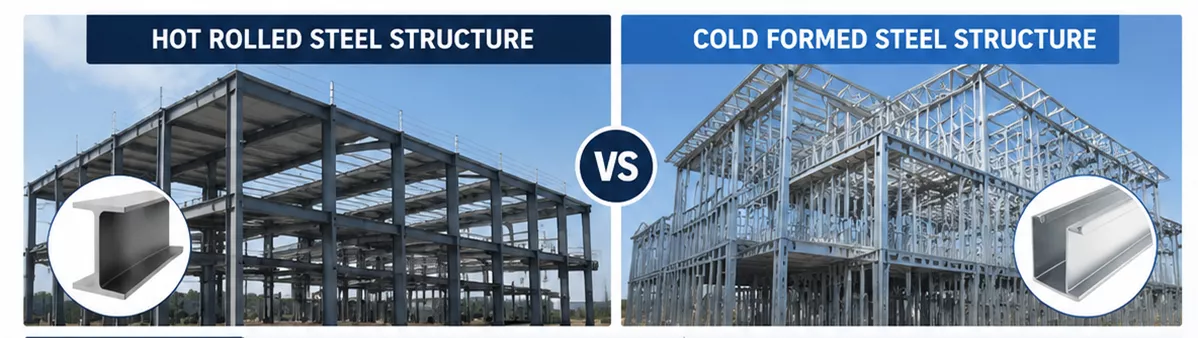
| Factor | Hot Rolled Steel Structure | Cold Formed Steel Structure |
|---|---|---|
| Material thickness | Roughly 6mm–40mm+, sometimes thicker for heavy columns | Roughly 1.5mm–6mm |
| Typical clear span | Comfortably handles 40–60m+, with special design going even further | Most efficient under 30m; beyond that, costs climb fast |
| Structural self-weight | Heavier — expect roughly 25-40 kg/m² of roof area for typical industrial buildings | Lighter — often 40-60% less steel weight than an equivalent hot rolled frame |
| Manufacturing tolerance | Good, but a few mm of variance is normal and often adjusted on-site | Very tight, since roll-forming is fully automated and repeatable |
| Installation method | Bolted connections plus on-site welding for larger joints; needs skilled welders | Mostly bolt-together assembly; crews can often work with basic tools |
| Erection speed | Slower — a mid-size industrial building might take several weeks longer to erect | Faster, since parts arrive pre-cut and pre-drilled, ready to bolt |
| Cost per ton | Lower cost per ton of raw steel, but you use more tons overall on smaller buildings | Higher cost per ton, but you use fewer tons — often the cheaper total for small/mid buildings |
| Freight efficiency | Heavier sections mean fewer building-equivalents per container | Lighter, stackable profiles fit more efficiently into standard containers |
| Load-bearing capacity | High — built for cranes, heavy machinery, multi-story loads | Moderate — fine for standard roof/wind loads, not built for heavy point loads |
| Wind & seismic behavior | Very robust, the standard choice in high-load design codes worldwide | Performs well when properly braced and connected — bracing design is critical here |
| Typical building height | Works for both single-story and multi-story | Almost always single-story, low-rise |
| Long-term maintenance | Thicker sections corrode more slowly even if coating is imperfect | Thinner sections need more careful attention to galvanizing/coating quality |
Start with what you're actually building. If there's a crane running the length of your factory, or you're stacking multiple floors on top of each other, don't even bother debating this — go hot rolled. The math just doesn't work any other way once you're dealing with concentrated heavy loads or compounding floor weight. On the flip side, if you're putting up a standard warehouse, a distribution center, or anything agricultural under about 30m span, cold formed steel is very likely your more sensible option, both technically and financially.
Then think about your budget honestly. This is where a lot of buyers get tripped up — they assume "thinner steel = cheaper steel," full stop. It's not that simple. Cold formed steel usually costs more per ton than hot rolled, but you need dramatically less of it for smaller spans, so the total project cost often comes out lower. Once your span pushes past that 30-40m range, though, the equation flips: cold formed sections start needing more intermediate supports and bracing to compensate for their lower individual capacity, and at some point you're spending more to make thin steel do a heavy steel job. That's the trap to avoid. For a fuller breakdown of what drives steel building pricing overall, this guide is worth a read: How Much Does a Steel Building Cost in 2026? Complete Price Guide
Factor in your actual construction conditions, not just the theory. If your project site is somewhere without a deep bench of experienced structural welders, cold formed steel's bolt-together assembly is genuinely a practical lifesaver — it lowers your dependency on skilled labor and shortens your build timeline. If you've got access to good welding crews and heavy lifting equipment already, hot rolled construction stops being intimidating and becomes just the standard, well-understood path.
And don't forget climate and site loading. If you're building somewhere with serious wind exposure or meaningful seismic risk, both systems can absolutely work — but the engineering has to be right. Cold formed structures lean heavily on proper bracing and connection detailing to perform well under lateral loads, so this is not a place to cut corners on design just to save cost.
"Cold formed steel is flimsy." This one comes up constantly, and it's just not accurate. A properly engineered cold formed structure meets exactly the same building codes and safety margins as a hot rolled one — it's simply matched to a different load range. Comparing a cold formed purlin to a hot rolled I-beam and calling one "weak" is a bit like comparing a bicycle to a truck and calling the bicycle badly made. They're built for different jobs.
"Hot rolled always costs more." Not necessarily, and this is the flip side buyers often miss. Once you're designing a large-span building, hot rolled steel can actually work out cheaper overall, because it needs far fewer intermediate columns and less secondary bracing than a cold formed design would require to span the same distance. The "expensive" material sometimes ends up being the more economical building.
"Cold rolled steel and cold formed steel are the same thing." This mix-up shows up constantly in online searches, so it's worth clearing up. Cold rolling is actually a separate process that refines flat steel sheet or coil — improving surface finish and dimensional accuracy — while cold forming (what we've been discussing throughout this article) is the process of bending that sheet into structural shapes like C-sections and Z-sections, all done at room temperature. In practice, most steel used in cold formed steel buildings has already been cold rolled at an earlier stage, so the terms get used loosely and interchangeably even though they technically describe different steps.
Can cold formed and hot rolled steel be combined in one building?
Absolutely, and honestly it's one of the smartest ways to build. A lot of real-world projects use hot rolled steel for the main frame — columns and primary beams — and then cold formed steel for the secondary structure like purlins and girts. You get the load capacity where it counts and the weight/cost savings everywhere else.
Which is more cost-effective for a 20m x 40m warehouse?
For a footprint that size with standard loading (no cranes, no unusual equipment), cold formed steel structure is typically going to come out ahead on total cost. That span is well within its comfort zone.
Is cold formed steel suitable for high wind or seismic zones?
Yes, as long as it's engineered properly — bracing and connection design are the make-or-break factors here, not the material itself. Cold formed buildings are used successfully in plenty of high-wind coastal regions and moderate seismic areas around the world.
How long does a light gauge steel building actually last?
With proper galvanized coating and reasonable maintenance, a light gauge steel structure typically lasts 30-50 years — comparable to many hot rolled buildings for low-rise applications. The coating matters more than people expect here, since the steel is thinner and has less "extra" material to sacrifice to corrosion over time compared to a heavy hot rolled section. We've covered lifespan factors in more detail here: How Long Do Prefabricated Steel Buildings Last?
Do I need a different foundation for cold formed vs hot rolled steel structures?
Generally, yes — foundations are sized to the actual load the building transfers down, and since cold formed structures are significantly lighter, they often allow for a lighter, less expensive foundation design. That said, this still needs proper engineering calculation based on your soil conditions and local building code, not just an assumption based on the frame type.
Still weighing it up? That's normal — this decision really does depend on your specific span, loads, and site conditions, and there's no one-size-fits-all answer. If you're sourcing internationally, it's also worth understanding how export pricing and shipping factor into your total cost: Steel Structure Building Export Price Guide 2026: Global Buyer Tips
Akoetech works with both hot rolled steel structures and prefabricated light gauge steel buildings, offering complete light gauge steel building systems as well as heavier hot rolled solutions depending on what your project actually needs. Our team can walk through the numbers with you, or drop us a line at info@akoetech.com.
Your Name*
Your Email*
*We respect your confidentiality and all information are protected.

Explore the top 5 precast concrete panels manufacturers in Canada in 2026. Compare architectural wall panels, insulated panels, facade solutions, products, services and manufacturer strengths.

Discover the top 5 precast concrete panels manufacturers in China in 2026. Compare their products, strengths, applications, and capabilities for custom precast concrete panels.

Free poured concrete wall cost calculator. Enter length, height and thickness to see a price range for 12 countries, materials and labor included.