
+86 136 0176 4940
info@akoetech.com
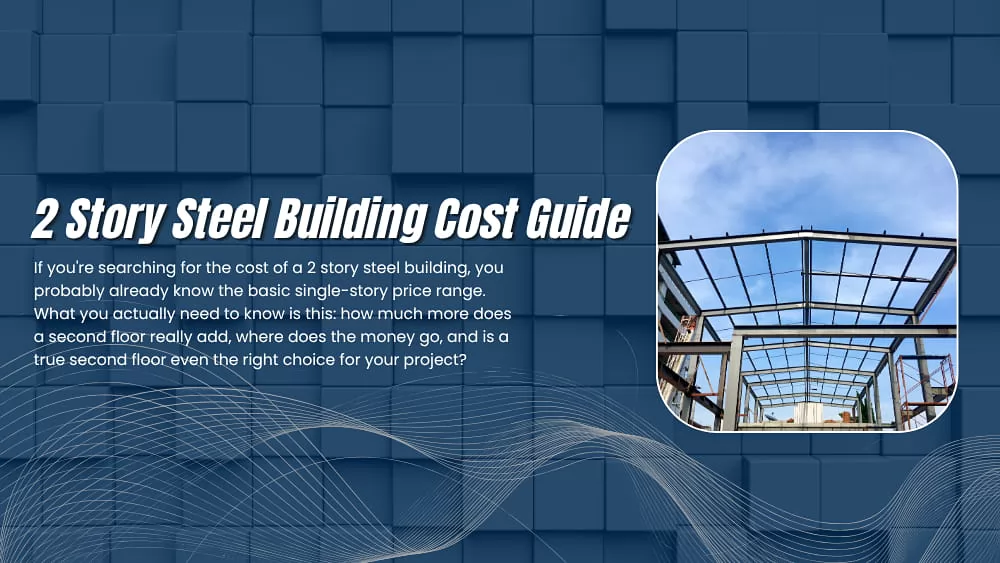
If you're searching for the cost of a 2 story steel building, you probably already know the basic single-story price range. What you actually need to know is this: how much more does a second floor really add, where does the money go, and is a true second floor even the right choice for your project?
Most articles hand you a number — $24 to $43 per square foot installed — and stop there. That figure is real, but it tells roughly half the story. The other half involves foundation engineering, structural load combinations, the mezzanine vs. true second floor decision, and a string of costs that almost every first-time builder underestimates by $30,000 to $80,000.
This guide is built around what buyers actually need to decide: a full price breakdown by use case, an honest two-story vs. mezzanine comparison, a foundation cost explainer, and a 20-year total cost comparison against wood-frame construction. Every number comes from verified industry data.
Table of Contents
All data in the table below is denominated in U.S. dollars (USD) and reflects the state of the U.S. market as of 2026.
| Building Type | Cost per Sq Ft (Installed) | Typical Total Range | What's Included |
|---|---|---|---|
| 2-story steel building (full second floor) | $24 – $43 / sq ft | $58,000 – $206,000+ | Structure, erection, standard doors & windows |
| Mezzanine platform (inside existing structure) | $15 – $25 / sq ft (mezzanine area only) | $18,000 – $60,000 | Steel platform, stairs, handrail — no new foundation |
| Single-story steel building (comparison) | $15 – $30 / sq ft | $18,000 – $150,000+ | Structure and erection only |
| Traditional 2-story wood frame | $35 – $50 / sq ft | $84,000 – $240,000+ | Framing, sheathing, standard finish |
| Foundation (two-story, all types) | $5 – $12 / sq ft | $12,000 – $55,000 | Concrete slab, footings, uplift engineering |
| Structural engineering fees (two-story) | — | $5,000 – $20,000 | Licensed PE drawings, load calculations, stamp |
Note: These figures cover the steel structure and installation only. Interior finish, HVAC, plumbing, electrical, insulation, and permits are separate line items covered later in this guide.
Before you price a two-story steel building, you need to answer one question that most buyers skip entirely: do you actually need a true second floor, or would a mezzanine do the job at half the cost?
These two options look similar from the outside but are structurally, legally, and financially very different. Getting this decision wrong at the planning stage is the single most expensive mistake buyers make.
A mezzanine is an intermediate platform installed within the clear height of an existing steel structure. It occupies part of the interior — typically 30 to 50 percent of the floor area — and sits between the ground floor and the roof. Critically, a mezzanine does not count as a separate floor under most building codes, which means it does not trigger the full structural, fire, and egress requirements that a true second floor does.
Mezzanines are available in two structural configurations. The first type shares its load path with the existing building columns, transferring weight through beams attached to the main steel frame. This approach requires verified residual capacity in those columns and their footings. The second type is a freestanding system — self-supporting steel legs sitting directly on the concrete slab — which avoids engaging the main frame entirely, though it still places loads on the slab and the soil beneath it. Neither option is "load-free," and both require engineering review.
A full second floor is designed into the building from the beginning. The structural framing, column sizes, beam depths, connection details, and foundation are all engineered to carry two full levels of occupancy loads simultaneously. This is not something you add after the fact without major expense. The foundation for a two-story steel building must be engineered to resist uplift forces equivalent to 60 percent of the dead load — a requirement that significantly increases footing size and reinforcement compared to a single-story slab.
A true second floor also triggers code requirements that a mezzanine avoids: two independent means of egress, fire separation between floors in many occupancy types, ADA-compliant vertical access (elevator or lift) for public buildings, and full permit and inspection process for each occupied level.
| Factor | Mezzanine | True Second Floor |
|---|---|---|
| Cost (additional space) | $15 – $25 / sq ft | $24 – $43 / sq ft (total building) |
| Counts as building floor area? | Usually no | Yes — full square footage |
| New foundation required? | Usually not | Always — uplift-rated design required |
| Licensed structural engineer required? | Recommended; often required | Always required |
| Minimum existing clear height needed | 14 ft minimum (16+ ft preferred) | Designed from scratch — 10 ft per level minimum |
| Installation timeline | Days to weeks | Months (design + construction) |
| Typical load capacity | 50 – 80 PSF live load | 80 – 125 PSF live load |
| Covers full footprint? | Partial (30 – 50% typical) | Full footprint |
| Fire separation required? | Usually not | Often yes, depending on occupancy |
| Two egress routes required? | Often not | Yes — code requirement |
| Best for | Storage, light offices, supervision areas | Full occupancy, residential, retail + office |
| Not suitable for | Heavy equipment, full residential, high occupancy | Tight budgets on existing buildings |
Decision rule: If you need the upper level for storage, light office use, or supervision and your existing building has 14 feet or more of clear height, a mezzanine will cost 40 to 60 percent less and install in a fraction of the time. If you need the upper level for full residential occupancy, high-density office, or anything with heavy foot traffic and building code scrutiny, budget for a true second floor.
The most common frustration buyers have is receiving a quote for a two-story building and finding it far higher than doubling the single-story price. This happens because the extra cost is not proportional to floor area — it comes from structural requirements that apply to the entire building, not just the second floor.
Larger steel sections throughout: Every column in a two-story building must carry the combined weight of both floors plus the roof, wind loads, and required safety factors. Column sizes and beam depths increase substantially compared to a single-story building of the same footprint. The added steel weight alone accounts for 15 to 25 percent of the cost premium.
Floor framing system: The second floor itself requires a dedicated structural floor system — typically steel joists and decking, or engineered wood joists on steel beams. This floor system costs $12 to $25 per square foot of floor area and is entirely absent in a single-story building.
Structural engineering fees: A single-story pre-engineered metal building (PEMB) often uses the manufacturer's standard engineering package, which is included in the kit price. A two-story building requires a licensed professional engineer (PE) to design and stamp custom load calculations, connection details, and foundation drawings. Engineering fees for two-story steel structures typically run $5,000 to $20,000 depending on building size and complexity.
Foundation upgrades: This is the cost most buyers do not anticipate. The foundation for a two-story steel building must handle not just vertical gravity loads, but also the uplift forces generated when wind pushes against the building. The industry standard is designing the foundation to resist uplift equal to 60 percent of the building's dead load. That requirement alone can add $15,000 to $40,000 to foundation costs compared to a single-story slab of the same footprint.
Stairs and vertical circulation: A functional second floor requires at least one staircase, and most codes require two means of egress. Steel stairs with handrails and landings cost $3,000 to $12,000 each depending on size and finish. If your use triggers ADA requirements, a commercial elevator adds $25,000 to $65,000 to the budget.
Construction equipment: Erecting a two-story building requires crane time and elevated work platforms that single-story builds often avoid. Labor costs per square foot are typically 20 to 35 percent higher for multi-story work.
| Cost Driver | Single-Story Impact | Two-Story Premium |
|---|---|---|
| Steel sections (columns, beams) | Base cost | +15 – 25% |
| Floor framing system | None | $12 – $25 / sq ft of floor area |
| Structural engineering fees | Included in kit (standard) | +$5,000 – $20,000 |
| Foundation (uplift design) | $4 – $8 / sq ft | $7 – $12 / sq ft (+$15,000–$40,000 typical) |
| Stairs and egress | None typically | $6,000 – $24,000 (two stairs) |
| Labor (elevated work) | Base | +20 – 35% |
| Permits and inspections | $500 – $2,000 | $1,500 – $5,000 (two occupied levels) |
Abstract per-square-foot ranges are useful for initial budgeting, but most buyers need to see what a project similar to theirs actually costs. Below are three common two-story steel building use cases with full cost breakdowns based on current market data.
The most common two-story steel building inquiry: a business owner wants to use ground floor space for storage, light manufacturing, or operations, and the upper floor for offices, meeting rooms, or a break area. This eliminates the need for a separate office lease.
| Item | Low Estimate | High Estimate | Notes |
|---|---|---|---|
| Building size: 40×60 ft, 2 stories (4,800 sq ft total) | — | — | 2,400 sq ft per floor |
| Steel structure + erection | $57,600 | $103,200 | $24–$43/sq ft × 4,800 sq ft |
| Foundation (uplift-rated) | $16,800 | $28,800 | $7–$12/sq ft × 2,400 sq ft footprint |
| Structural engineering | $7,000 | $15,000 | Licensed PE drawings and stamp |
| Floor framing system (upper level) | $28,800 | $60,000 | $12–$25/sq ft × 2,400 sq ft |
| Two staircases | $7,000 | $18,000 | Code-compliant steel stairs with handrails |
| Permits and inspections | $1,500 | $4,000 | Varies significantly by municipality |
| Soil testing (geotechnical) | $1,500 | $5,000 | Required for two-story uplift design |
| Subtotal (structure only) | $120,200 | $234,000 | No interior finish, HVAC, electrical |
| Interior finish, HVAC, electrical (office level) | $50,000 | $120,000 | $20–$50/sq ft on 2,400 sq ft office floor |
| Total project estimate | $170,200 | $354,000 | Turnkey, ready to occupy |
Barndominiums are one of the fastest-growing steel building categories in the United States. A two-story barndominium typically places bedrooms and living spaces on the upper level and a garage, workshop, or barn on the ground floor. The cost is substantially higher than commercial construction because residential use triggers stricter energy codes, insulation requirements, and finish expectations.
| Item | Low Estimate | High Estimate | Notes |
|---|---|---|---|
| Building size: 30×50 ft, 2 stories (3,000 sq ft total) | — | — | 1,500 sq ft per floor |
| Steel structure + erection | $36,000 | $64,500 | $24–$43/sq ft × 3,000 sq ft |
| Foundation (residential-grade uplift) | $10,500 | $18,000 | $7–$12/sq ft × 1,500 sq ft footprint |
| Structural engineering | $6,000 | $12,000 | Residential PE stamp |
| Floor framing (living level) | $18,000 | $37,500 | $12–$25/sq ft × 1,500 sq ft |
| Interior finish — living level (insulation, drywall, flooring, kitchen, bath) | $75,000 | $225,000 | $50–$150/sq ft — the biggest variable in residential builds |
| Plumbing, HVAC, electrical | $30,000 | $75,000 | Full residential systems |
| Permits (residential) | $2,000 | $8,000 | Residential permits often higher than commercial |
| Total project estimate | $177,500 | $440,000 | Interior finish quality drives the range |
The wide range in the barndominium estimate reflects finish quality almost entirely. A basic functional interior (painted drywall, vinyl flooring, standard fixtures) lands near the low end. High-end finishes (hardwood floors, custom cabinetry, tile, upgraded HVAC) push toward the top.
A growing number of retail businesses are choosing two-story steel buildings to accommodate customer-facing showroom or sales floor on the ground level with administrative offices, training rooms, or storage on the upper floor. This configuration requires particular attention to ADA accessibility and means of egress.
| Item | Low Estimate | High Estimate | Notes |
|---|---|---|---|
| Building size: 50×80 ft, 2 stories (8,000 sq ft total) | — | — | 4,000 sq ft per floor |
| Steel structure + erection | $96,000 | $172,000 | $24–$43/sq ft × 8,000 sq ft |
| Foundation | $28,000 | $48,000 | $7–$12/sq ft × 4,000 sq ft footprint |
| Structural engineering | $10,000 | $20,000 | Commercial occupancy, larger span |
| Floor framing (office level) | $48,000 | $100,000 | $12–$25/sq ft × 4,000 sq ft |
| ADA elevator (public building requirement) | $25,000 | $65,000 | Required when public has upper-floor access |
| Two egress staircases | $10,000 | $24,000 | Commercial-grade with fire rating |
| Interior fit-out (both floors) | $80,000 | $200,000 | $10–$25/sq ft on 8,000 sq ft |
| Permits, fire inspection, sprinkler system | $15,000 | $40,000 | Commercial occupancy triggers sprinkler requirement in many jurisdictions |
| Total project estimate | $312,000 | $669,000 | Wide range driven by finish level and elevator requirement |
Of all the cost categories in a two-story steel building project, foundation is the one most buyers get wrong — not because it's unpredictable, but because the general figures published online (usually cited as $4 to $8 per square foot) are based on single-story buildings and do not reflect what a two-story structure actually demands.
A two-story steel building foundation must be engineered to handle four distinct categories of load simultaneously. Understanding these helps you ask the right questions and evaluate engineer proposals.
Dead Load is the weight of the structure itself — steel framing, floor decking, roofing, and any permanent equipment. For a two-story steel building, dead loads typically range from 15 to 25 PSF (pounds per square foot) per level.
Live Load is the weight of occupants, furniture, and movable equipment. Building codes prescribe minimum live loads based on use: office floors are typically designed for 50 PSF, retail floors for 75 to 100 PSF, storage for 125 PSF or more. The second floor in a two-story building must carry full design live loads, and these loads transfer all the way to the foundation.
Collateral Load covers hanging systems and mechanical equipment that are not part of the primary structure but attach to it. Common collateral loads in two-story buildings include fire sprinkler systems (3 to 4 PSF), suspended ceiling systems (4 PSF), solar panel arrays on the roof (9 PSF), and HVAC units. Engineers must include all collateral loads in the structural design, and each one affects the foundation sizing.
Environmental Load — wind and snow — is where two-story buildings diverge most sharply from single-story structures. A taller building presents more surface area to wind, which creates both lateral (sideways) forces and uplift forces on the roof and walls. The foundation must resist the tendency of the building to rock or lift under wind loading. Industry standard for two-story steel buildings is designing the foundation to resist uplift forces equal to 60 percent of the total dead load. This requirement drives the size of anchor bolts, footing depth, and the amount of concrete required.
A single-story slab on grade can often be designed using conservative assumptions about soil bearing capacity without formal testing. A two-story building cannot. The uplift and lateral forces unique to multi-story construction require that the engineer know the actual soil conditions: bearing capacity, plasticity index, moisture content, and frost depth in northern climates.
A geotechnical report (soil test) costs $1,500 to $5,000. Buyers who skip this step to save money routinely discover foundation problems during construction that cost $15,000 to $80,000 to fix — and cannot be hidden from inspectors. The geotechnical report is the lowest-cost insurance policy in any two-story steel building project.
| Building Footprint | Low Foundation Cost | High Foundation Cost | Key Driver |
|---|---|---|---|
| 30×40 ft (1,200 sq ft) | $8,400 | $14,400 | Anchor bolt pattern, footing depth |
| 40×60 ft (2,400 sq ft) | $16,800 | $28,800 | Uplift load from taller eave height |
| 50×80 ft (4,000 sq ft) | $28,000 | $48,000 | Seismic zone and wind exposure category |
| 60×100 ft (6,000 sq ft) | $42,000 | $72,000 | Grade beams, multiple isolated footings |
| Soil testing (all sizes) | $1,500 | $5,000 | Required for uplift engineering |
This is the comparison that no other article publishes, but it's the one that actually helps buyers make the right decision. Suppose you need to add 2,400 square feet of usable space to your current building situation. Here are the three realistic paths, compared on initial cost and 20-year total ownership cost.
| Scenario | Initial Build Cost | Annual Maintenance (20-yr avg) | Annual Energy Cost (est.) | 20-Year Total Cost |
|---|---|---|---|---|
| Option A: 2-story steel building (40×60 ft, 4,800 sq ft total on same footprint as existing 2,400 sq ft) | $120,000 – $234,000 | 1% of value = $1,500 – $2,500/yr | $3,500 – $6,000/yr (insulated) | $220,000 – $394,000 |
| Option B: Mezzanine inside existing structure (1,200 sq ft platform covering half the building) | $18,000 – $30,000 | Under $500/yr (minimal) | No additional — existing HVAC | $28,000 – $40,000 |
| Option C: Larger single-story steel building (60×80 ft = 4,800 sq ft, starting from scratch) | $72,000 – $144,000 | $1,000 – $2,000/yr | $4,000 – $7,500/yr (larger footprint) | $172,000 – $294,000 |
| Option D (benchmark): Equivalent 2-story wood-frame construction | $168,000 – $240,000 | 2 – 4% of value = $4,000 – $9,600/yr | $5,000 – $9,000/yr (less efficient) | $348,000 – $612,000 |
The comparison reveals three important insights. First, if a partial mezzanine meets your space needs, it delivers dramatically lower cost with minimal disruption — the right answer for many storage, light office, and supervision applications. Second, a two-story steel building beats comparable wood-frame construction by $40,000 to $100,000 over 20 years, even with higher upfront structural costs. Third, if you need the maximum footprint flexibility, a larger single-story on new land may cost less than a two-story on a constrained site — but only if land is available and affordable.
The $24 to $43 per square foot range for two-story steel buildings is wide for a reason. Every project lands somewhere on that spectrum based on the following variables.
Building location affects cost in two ways: construction labor rates and local code requirements. Labor rates in the Northeast and West Coast run 15 to 25 percent above the national average, while the Southeast and Midwest are typically at or below average. More importantly, local codes dictate the engineering requirements your building must meet. A building in coastal Florida faces hurricane wind loads that require significantly heavier steel sections than the same building in Kansas. A building in Alaska must handle 80 to 100 PSF snow loads. A building in the Pacific Northwest has both seismic and snow load requirements. Always get a site-specific engineering quote, not a national average estimate.
For two-story steel buildings, eave height is the most direct driver of cost after footprint. Most two-story configurations require a minimum eave height of 20 to 24 feet to accommodate two usable floor levels with adequate headroom. Each additional foot of eave height adds material to every column and wall panel. The standard two-story configuration runs from 20 to 28 feet at the eave, with commercial and industrial applications reaching 30 feet or higher.
A clear-span steel building uses no interior columns, giving you 100 percent usable floor space at the cost of heavier primary framing. A multi-span building uses interior columns to reduce beam size and weight, lowering material cost but introducing column locations that constrain the floor plan. For two-story buildings, the impact of this choice is amplified: interior columns on the ground floor must align with structural requirements on the upper floor, limiting your layout flexibility. Clear-span configurations up to 80 feet wide are common for two-story commercial builds; beyond that, multi-span becomes structurally and economically necessary.
Standard pre-engineered metal building packages (PEMBs) include the primary and secondary structural steel, roof and wall panels, standard framed openings, and basic trim. Everything else is an upgrade. Common cost additions in two-story builds include: insulated wall panels instead of bare metal ($3 to $8 per square foot), skylights ($400 to $1,500 each), wainscoting or alternative exterior cladding ($5 to $15 per square foot), interior liner panels ($2 to $5 per square foot), and walk doors or overhead doors beyond the standard package.
Hot-rolled steel is a commodity. Its price fluctuates with global supply and demand, energy costs, and trade policy. Steel prices rose more than 150 percent during the 2021–2022 period, then retreated substantially. As of 2025, prices have stabilized, making this a relatively favorable environment for buyers. However, a quote received today may not be valid in 90 days. Most manufacturers offer price locks for 30 to 60 days. Buyers who can commit to a purchase quickly capture more certainty in their budgeting.
Two-story steel buildings consistently outperform wood-frame construction on total cost of ownership, but the advantage is often understated because most comparisons stop at initial construction cost. The real financial case for steel becomes clear only when you account for the full cost over the building's useful life.
| Cost Category | 2-Story Steel Building | 2-Story Wood Frame | Steel Advantage |
|---|---|---|---|
| Initial construction (4,800 sq ft example) | $120,000 – $234,000 | $168,000 – $240,000 | Often 10 – 30% lower |
| Annual maintenance (% of value) | ~1% | 2 – 4% | $2,500 – $7,500/yr savings |
| Insurance premiums (20-year total) | 10 – 30% lower | Baseline | $10,000 – $40,000 savings |
| Pest/rot remediation (20 years) | None — steel is immune | $5,000 – $25,000 typical | $5,000 – $25,000 savings |
| Energy costs (insulated steel vs. wood frame) | 20 – 30% lower with proper insulation | Baseline | $15,000 – $40,000 savings (20 yr) |
| Structural lifespan | 50 – 100+ years with minimal intervention | 30 – 50 years typical | Longer asset life |
| Estimated 20-year total savings (steel vs. wood) | — | $40,000 – $100,000+ | |
The maintenance advantage is the most significant long-term differentiator. Wood-frame buildings require regular treatment for moisture, pests, rot, and UV degradation. Steel requires periodic inspection, occasional re-sealing of penetrations, and touch-up of any scratched exterior coatings. The result is annual maintenance costs running at roughly one percent of building value for steel versus two to four percent for wood — a gap that compounds significantly over two decades.
These are not rare edge cases. They appear regularly in contractor forums, building permit disputes, and insurance claims. Being aware of them before you start budgeting is worth real money.
This is the most common budgeting error, and it leads to sticker shock at the first contractor quote. A 40×60 ft single-story steel building might cost $57,600 to $72,000 installed ($24–$30/sq ft × 2,400 sq ft). The instinct is to double that for a two-story version: $115,000 to $144,000. The actual cost for the two-story equivalent is more likely $150,000 to $234,000 before interior finish — because the foundation, floor framing, engineering, and egress costs do not scale linearly with floor area. Budget $30,000 to $80,000 more than a simple doubling calculation suggests.
Mezzanines are typically designed for light loads: 50 to 80 PSF for storage or office use. They are not interchangeable with a full structural second floor. Placing heavy machinery, dense rack storage, or large gatherings on a mezzanine designed for lighter loads creates structural stress that can lead to connection failures over time — often without visible warning signs until the problem becomes serious. If your upper level needs to handle concentrated point loads from machinery or high-density rack systems, specify those loads to the engineer before the mezzanine is designed, not after it's installed.
The logic seems reasonable at the time: the neighboring building went up fine without a soil test, the lot looks flat and solid, and $3,000 is real money. The problem is that soil conditions vary dramatically even within a single property, and the uplift engineering required for two-story steel buildings leaves zero margin for assumptions. Buyers who skip soil testing and discover bearing capacity problems or expansive clay soils during construction face foundation remediation costs that routinely run $20,000 to $80,000 — and cannot be concealed from the structural inspector. The geotechnical report is the one expenditure in a two-story steel building project where the cost-to-risk ratio is unambiguously in favor of spending the money.
Expect to pay 30 to 50 percent more per square foot for a two-story building compared to a single-story of the same footprint, and significantly more in total project cost due to foundation upgrades, floor framing, structural engineering fees, and egress requirements. A 40×60 ft single-story might run $57,600 to $103,200 installed; the two-story version of the same footprint typically runs $120,000 to $234,000 for structure alone before interior finish.
Not all manufacturers. Standard pre-engineered metal building (PEMB) suppliers design primarily for single-story applications. Two-story buildings require custom load calculations and structural engineering that goes beyond the standard PEMB design package. When requesting quotes, specifically ask whether the supplier has designed and built true two-story structures before, and ask for references. Some suppliers will design the building but require you to engage your own structural engineer for the foundation and upper-floor framing.
Design and permitting typically takes 6 to 16 weeks depending on the complexity and your local building department's review timeline. Erection of the steel structure for a two-story building typically takes 2 to 6 weeks depending on size and crew availability. Interior finish adds additional time proportional to the scope. Total project timelines from first contact to occupancy commonly run 6 to 12 months for a two-story commercial building.
This depends on your jurisdiction, the building's occupancy classification, and its total square footage. Many commercial occupancies trigger automatic sprinkler requirements at 5,000 to 12,000 square feet or when the second floor is occupied. Residential barndominium builds generally do not require sprinklers unless local codes specify otherwise. Always confirm sprinkler requirements with your local building department before finalizing your budget — sprinkler systems for a two-story commercial building typically add $15,000 to $45,000 to the project cost.
If land is not a constraint, a larger single-story building is almost always cheaper to build and simpler to permit. The two-story configuration becomes cost-competitive or superior when land cost is high, the property footprint is limited by lot size or setback requirements, or when building up is the only way to achieve the desired square footage. In urban or suburban markets where land prices are significant, a two-story steel building on a smaller lot frequently delivers better total-cost economics than a larger single-story on a bigger lot.
It depends entirely on whether the existing foundation and structural frame were designed to carry the additional loads. Most single-story steel buildings are not engineered for a future second floor. Adding one requires a structural engineer to assess the existing frame, foundation, and connections, and in most cases significant upgrades are needed — new or reinforced footings, heavier columns, and potentially rebuilding portions of the primary frame. It is almost always more economical to specify a two-story building from the start than to add a second floor to an existing single-story structure.
To achieve two usable floor levels with adequate headroom, the overall eave height typically needs to be at least 20 feet, though 22 to 24 feet is more comfortable. The first floor needs a minimum of 10 to 12 feet of clear height (more for commercial uses), the floor framing system consumes 12 to 18 inches, and the second floor needs at least 8 to 10 feet of clear height above that. Adding these up: a livable two-story layout starts at roughly 20 to 22 feet from slab to eave, before any roof slope above that level.
The most common financing paths are commercial construction loans (for business use), SBA 504 loans (for owner-occupied commercial real estate), agricultural loans through Farm Credit or USDA programs (for rural applications), and conventional construction-to-permanent mortgages (for residential barndominiums). Some steel building manufacturers offer in-house financing or connect buyers with preferred lenders. Interest rates and terms vary significantly — having your plans and a contractor estimate ready before approaching lenders shortens the approval process substantially.
| Item | Typical Cost | Often Forgotten? |
|---|---|---|
| Geotechnical (soil) report | $1,500 – $5,000 | Frequently omitted |
| Licensed structural engineer (PE) fees | $5,000 – $20,000 | Often assumed to be included in kit price |
| Building permits (two occupied levels) | $1,500 – $5,000 | Underestimated |
| Site preparation and grading | $3,000 – $25,000 | Highly variable, often overlooked |
| Utility connections (water, sewer, electric) | $5,000 – $30,000 | Depends on distance from street |
| Second means of egress (required for two-story) | $3,000 – $12,000 per staircase | Missed in initial estimates |
| ADA elevator or lift (public buildings) | $25,000 – $65,000 | Legally required, often not budgeted |
| Fire sprinkler system (if triggered) | $15,000 – $45,000 | Depends on occupancy and jurisdiction |
| Insulation (entire building envelope) | $2 – $5 / sq ft installed | Not included in standard kit |
| HVAC system (both levels) | $15,000 – $60,000 | Always separate from structure |
| Electrical service and panel upgrade | $8,000 – $25,000 | Two-story often requires larger service |
| Architect fees (if required) | 7% of construction cost | Required by some jurisdictions for occupied buildings |
Free Download: Budget Items Most Buyers Forget
Building a 2-story steel structure? Hidden costs can derail your budget fast. Download our free checklist and make sure every dollar is accounted for.
The numbers in this guide give you a realistic framework for planning and evaluating quotes. But every two-story steel building project is different, and your actual cost depends on your footprint, location, occupancy type, soil conditions, and finish level in ways that no published guide can fully capture.
To get a price that reflects your specific situation, you'll need a quote that accounts for your local building codes, a geotechnical report for your site, and input from a licensed structural engineer who has built two-story steel structures before. Use this guide as your baseline and as a checklist to verify that every line item above appears in the quotes you receive — the difference between buyers who stay on budget and those who don't almost always comes down to which items were in the scope and which weren't.
Your Name*
Your Email*
*We respect your confidentiality and all information are protected.

Thinking precast or poured concrete? See real 2026 pricing, PSI strength numbers, and which one actually fits your wall height and timeline.

Discover the Top 10 Precast Concrete Panels Manufacturers in UAE 2026. Compare leading suppliers of precast concrete wall panels, architectural panels, insulated panels, and custom precast solutions for residential, commercial, and industrial projects.

Discover the Top 10 Precast Concrete Panels Manufacturers in the UK 2026. Compare leading suppliers of precast concrete wall panels, architectural panels, facade solutions, and custom concrete panel systems for construction projects.